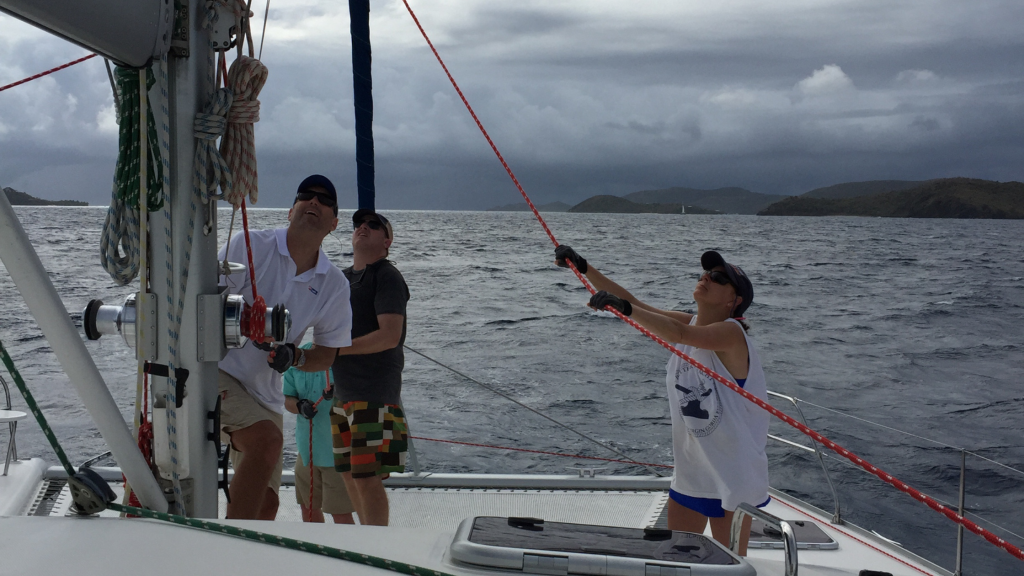
Setting a direction you can return to — not a destination you grip.
A rhumb line is a sailor’s line of constant bearing. Not the line from where you are to where you are going — that is the wishful line, the one the wind never quite lets you sail. A rhumb line is the heading you commit to and return to, hour after hour, watch after watch. The destination is implied by the bearing. What you actually hold is the direction.
It is one of the more honest ideas in navigation. And it turns out to be one of the more honest ideas in leadership development as well.
The bearing, not the harbor
Most leaders are trained to grip the harbor. We learn to set quarterly targets, to measure forecast against actual, to define the destination so precisely that every deviation feels like failure. That works for short runs in fair weather. It fails badly the moment the conditions change — and on any worthwhile passage, the conditions always change.
The rhumb line offers a different relationship with motion. You set a bearing because that is what you can hold. The wind will shift. Currents will push you off. The chart may not match the water. None of that matters to the bearing itself; what matters is whether you can keep returning to it. The sailor who reaches port is not the one who refused to be moved. It is the one who knew how to come back to the heading every time the sea had its say.
This is the shape of real growth. It is also the shape of the nine-month integration journey that follows a CLQ retreat.
A bearing is something you return to, not something you arrive at.
What we want to be celebrating in nine months
One of the questions we ask leaders at CLQ is this: nine months from now, what do you want to be celebrating? Not what do you want to have produced. Not what number do you want to have hit. What do you want to be celebrating — meaning what shift, what evidence of growth, what new way of being that was not available to you before?
The question is doing a particular kind of work. It asks for a direction without locking in an outcome. A leader who says “I want to be celebrating that I no longer carry the team’s anxiety home with me at night” has named a heading. They have not named a transaction. They cannot game it. They cannot reverse-engineer the steps and check them off. What they can do is set the bearing and start sailing toward it.
Nine months later, the celebration almost never looks the way they expected. It is usually better, and almost always different. Something else opened along the way. A relationship healed they did not realize was broken. A capacity emerged they did not know they had. The outcome was not the point. The bearing was the point — and the bearing produced something the gripped version of the goal could never have produced.
Ritual as the rhumb line
Holding a bearing for nine months is not an act of willpower. It is a practice. As Arthur Brooks teaches, meaning is not a state we arrive at — it is a practice we return to. A ritual. A place we come back to consistently, to do the work. Without the returning, the bearing drifts. With the returning, the bearing becomes the through-line of a life.
This is why CLQ pairs the retreat with nine months of coaching and wisdom sessions, and why the work between sessions matters as much as the sessions themselves. Ritual is what makes the heading visible on a Tuesday morning when nothing in your inbox cares about your transformation. The morning practice. The weekly cohort call. The somatic check-in before a hard conversation. None of these are the destination. All of them are returns to the bearing.
Intention without attachment is not the same as passivity. It is the discipline of being clear about the direction and humble about the path. You commit to the heading. You release the demand that the wind cooperate. And then you do the small, repeated work of coming back, again and again, to the line you set.
The line you can hold
There is a paradox here that the leaders who do this work tend to discover for themselves. The less tightly we grip the outcome, the more truly we move toward it. The bearing held loosely produces results the bearing held in a fist cannot. Something in the releasing makes room for what wanted to arrive all along.
Nine months is a long sail. It is long enough for the weather to turn several times, long enough for the original chart to look quaint by the end, long enough for the leader who set the bearing to become someone slightly different than the one who set it. That is not a failure of the plan. That is the plan working.
What bearing would you set today if you trusted that holding it — and returning to it, and returning to it again — would be enough?
Conscious Leaders Quest guides leaders through the inward journey of personal transformation that integrates mind, body, and business so they can become the leaders the world truly needs them to be. The next cohort gathers in Guanacaste, Costa Rica.
Ron Hill is the Co-Founder, Guide, and Managing Partner of Conscious Leaders Quest, a transformational leadership program for leaders ready to integrate mind, body, and business. Learn more at clquest.com/.